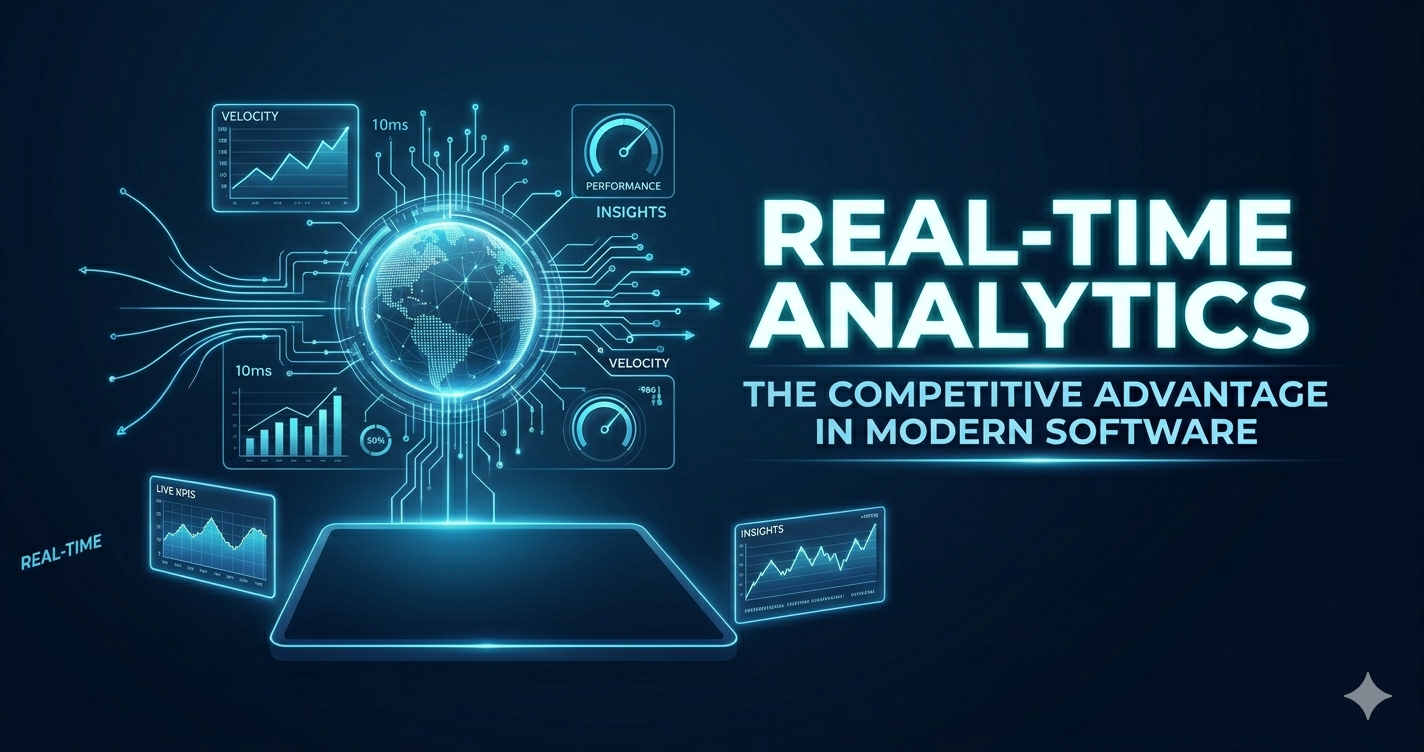
In today’s fast-paced digital economy, businesses can no longer afford to rely on outdated insights. Decisions made minutes too late can result in lost opportunities, reduced customer satisfaction, and operational inefficiencies.
This is where real-time analytics becomes a game-changer.
By enabling organizations to process and analyse data instantly, real-time analytics empowers decision-makers with up-to-the-minute insights. Whether it's monitoring customer behaviour, tracking operational performance, or identifying risks, businesses that leverage live data analytics gain a significant competitive edge.
Modern software solutions are increasingly built around this
capability—transforming raw data into immediate, actionable intelligence.
What is Real-Time Analytics?
Real-time analytics refers to the process of collecting, processing, and analysing data as it is generated, delivering insights instantly or within seconds.
Real-Time Analytics vs Traditional Analytics
|
Aspect |
Real-Time Analytics |
Traditional Analytics |
|
Data Processing |
Instant |
Delayed (hours/days) |
|
Decision Making |
Immediate |
Retrospective |
|
Data Relevance |
Highly current |
Often outdated |
|
Use Case |
Live monitoring, alerts |
Reports, historical analysis |
Traditional analytics focuses on historical data, while real-time
data processing enables businesses to act in the moment.
Why Real-Time Analytics Matters
1. Faster, Smarter Decision-Making
With real-time dashboards, businesses can:
- Monitor
performance instantly
- Detect
anomalies early
- Make
data-driven decisions on the spot
This reduces dependency on guesswork and outdated reports.
2. Enhanced Customer Experience
Understanding customer behaviour in real time allows
businesses to:
- Personalize
user experiences
- Recommend
relevant products/services
- Resolve
issues instantly
This is especially critical in competitive industries like
SaaS and e-commerce.
3. Operational Efficiency
Real-time insights help organizations:
- Identify
bottlenecks instantly
- Optimize
workflows
- Reduce
downtime and inefficiencies
4. Competitive Advantage
Companies using business intelligence tools with
real-time capabilities can:
- React
faster than competitors
- Identify
trends before others
- Innovate
continuously
Key Features of Real-Time Analytics Systems
Modern SaaS analytics software typically includes:
1. Real-Time Data Processing
Continuous ingestion and processing of streaming data from
multiple sources.
2. Interactive Real-Time Dashboards
Visual interfaces displaying KPIs, metrics, and alerts
instantly.
3. Event-Driven Architecture
Triggers actions based on specific data events (e.g.,
alerts, notifications).
4. Scalability
Ability to handle large volumes of data without performance
issues.
5. Data Integration
Seamless connection with CRM, ERP, IoT devices, and other
systems.
6. Predictive Insights
Combines real-time and historical data for forecasting
trends.
Industry Use Cases of Real-Time Analytics
1. Finance
- Fraud
detection through live transaction monitoring
- Risk
assessment in real time
- Algorithmic
trading
2. E-commerce
- Personalized
product recommendations
- Real-time
inventory tracking
- Dynamic
pricing strategies
3. Healthcare
- Patient
monitoring systems
- Real-time
diagnostics
- Emergency
response optimization
4. Logistics & Supply Chain
- Fleet
tracking and route optimization
- Delivery
status updates
- Warehouse
management
5. SaaS Businesses
- User
behaviour tracking
- Feature
usage analytics
- Customer
churn prediction
Technologies Behind Real-Time Analytics
Real-time analytics systems rely on advanced technologies
such as:
1. Stream Processing Frameworks
Tools that process data continuously as it flows into the
system.
2. Cloud Computing
Cloud platforms provide scalability and flexibility for
handling large data streams.
3. Data Warehouses & Data Lakes
Centralized storage systems optimized for analytics
workloads.
4. APIs & Integration Tools
Enable seamless data exchange between applications.
5. AI & Machine Learning
Enhance real-time insights with predictive and prescriptive
analytics.
Challenges in Implementation (and How to Overcome Them)
1. Data Volume & Complexity
Challenge: Managing large-scale data streams
Solution: Use scalable cloud-based architectures and distributed systems
2. Integration Issues
Challenge: Connecting multiple data sources
Solution: Implement robust APIs and middleware solutions
3. Cost of Infrastructure
Challenge: High setup and maintenance costs
Solution: Adopt cloud-based SaaS analytics software to reduce
upfront investment
4. Data Accuracy & Quality
Challenge: Inconsistent or unreliable data
Solution: Implement data validation and governance frameworks
5. Skill Gaps
Challenge: Lack of expertise in advanced analytics
Solution: Choose user-friendly platforms with intuitive dashboards
Best Practices for Implementing Real-Time Analytics
To successfully adopt real-time analytics, businesses
should:
- Define
Clear Objectives
Identify what you want to achieve (e.g., improve customer experience, optimize operations) - Choose
the Right Tools
Select scalable business intelligence tools with real-time capabilities - Ensure
Data Quality
Clean, structured data is critical for accurate insights - Focus
on User Experience
Use intuitive real-time dashboards for better decision-making - Start
Small and Scale
Begin with a pilot project and expand gradually - Prioritize
Security
Protect sensitive data with strong security measures
Future Trends in Real-Time Analytics
The future of live data analytics is driven by
innovation and evolving business needs.
1. AI-Driven Real-Time Insights
Artificial intelligence will automate decision-making and
anomaly detection.
2. Edge Computing
Processing data closer to the source for faster insights.
3. Hyper-Personalization
Real-time data will enable highly customized user
experiences.
4. Embedded Analytics
Analytics capabilities will be integrated directly into
business applications.
5. Democratization of Data
More user-friendly tools will allow non-technical users to
leverage analytics.
Turning Data into Instant Action
In a world where speed defines success, real-time
analytics is no longer a luxury—it’s a necessity.
Businesses that embrace real-time data processing
gain the ability to:
- Make
faster decisions
- Deliver
superior customer experiences
- Optimize
operations
- Stay
ahead of competitors
Modern SaaS analytics software and business
intelligence tools are making it easier than ever to unlock the power of
live data.
Transform Your Business with Real-Time Analytics
Ready to unlock the full potential of your data?
Discover how our intelligent software solutions can help you implement real-time analytics, build powerful real-time dashboards, and drive smarter business decisions.