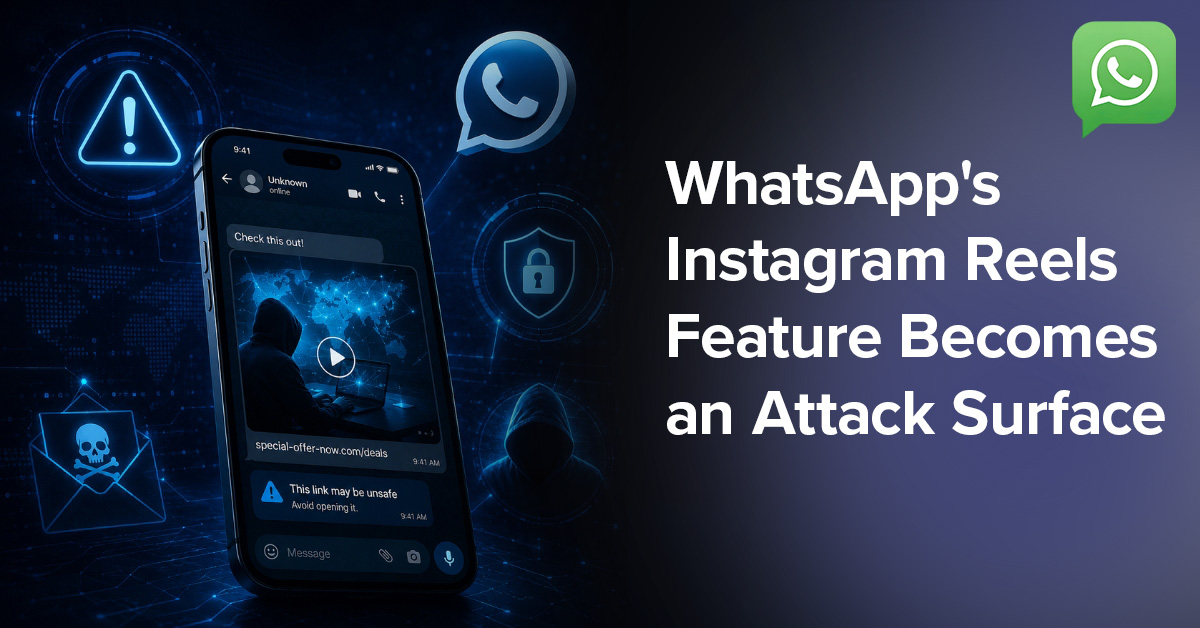
Two newly disclosed vulnerabilities in WhatsApp — one tied to Instagram Reels integration and another affecting its Windows client — demonstrate how deeply interconnected platform features can quietly expand an app's attack surface.
Two newly disclosed vulnerabilities in WhatsApp — one tied to Instagram Reels integration and another affecting its Windows client — demonstrate how deeply interconnected platform features can quietly expand an app's attack surface.
At a glance: Meta has patched both flaws. If you haven't updated WhatsApp on iOS, Android, or Windows recently, now is the time.
The Instagram Reels Flaw (CVE-2026-23866)
The first vulnerability sits inside the way WhatsApp processes AI-generated rich-response messages — the kind that surface Instagram Reels previews directly inside a conversation. When these messages arrive, WhatsApp is supposed to validate where the embedded media is actually coming from. It doesn't do that job completely.
The practical consequence: a carefully crafted message can point the victim's device at a URL of the attacker's choosing. If that URL uses a custom URL scheme — the kind that can invoke native OS capabilities — the device may process it without ever asking the user for permission.
This isn't a remote code execution bug in the classical sense, but it's a meaningful stepping stone. In targeted operations, the ability to silently invoke OS-level handlers on a victim's device is a technique that spyware authors have exploited repeatedly.
Medium severity No interaction beyond receiving a message Patched by Meta
Affected versions
| Platform | Vulnerable range | Safe from |
|---|---|---|
| WhatsApp for iOS | v2.25.8.0 – v2.26.15.72 | v2.26.15.73 and above |
| WhatsApp for Android | v2.25.8.0 – v2.26.7.10 | v2.26.7.11 and above |
The Windows Attachment Spoof (CVE-2026-23863)
The second issue is different in character and arguably more immediately dangerous to everyday users. WhatsApp for Windows, prior to version v2.3000.1032164386.258709, could be tricked into misrepresenting what kind of file an attachment actually is.
The trick relies on NUL byte injection — inserting a null character (\x00) into a filename string. High-level application logic reads the filename and sees something innocuous, like a PDF. The lower-level system call, however, truncates at the null byte and sees a different extension entirely. The result is that a file visually presented as a document can silently execute as an executable.
All it takes is a single click.
NUL byte poisoning is a well-understood technique, and its presence in a major messaging application is a reminder that even mature codebases can carry subtle parsing assumptions that attackers know how to exploit.
How serious is this, really?
Meta has confirmed there is no evidence of active exploitation for either flaw at the time of disclosure. The vulnerabilities were reported through Meta's Bug Bounty Program by external researchers and confirmed independently before patches were released — a process that reflects reasonably responsible handling.
That said, "no evidence of exploitation" is a limited reassurance. WhatsApp's user base exceeds two billion people. A vulnerability that requires only a specially crafted message and no unusual user action is precisely the kind of primitive that nation-state actors and commercial spyware vendors invest in finding. The window between disclosure and widespread patching is the riskiest period.
What to do now
Update WhatsApp on iOS to any version above v2.26.15.72
Update WhatsApp on Android to any version above v2.26.7.10
Update WhatsApp for Windows to v2.3000.1032164386.258709 or later
Enterprise teams should push mandatory app-update policies via MDM
Monitor network traffic for unusual URL scheme calls originating from messaging apps
Brief end users on the risks of unexpected rich-media messages, especially from unknown contacts
The broader takeaway is structural: as messaging platforms absorb richer content formats — AI-generated previews, embedded media, cross-platform integrations — each new surface is a potential entry point. Validation logic that was written before AI-rich messages existed may not account for the range of inputs those messages can carry. Security reviews need to keep pace with feature development, not lag behind it.