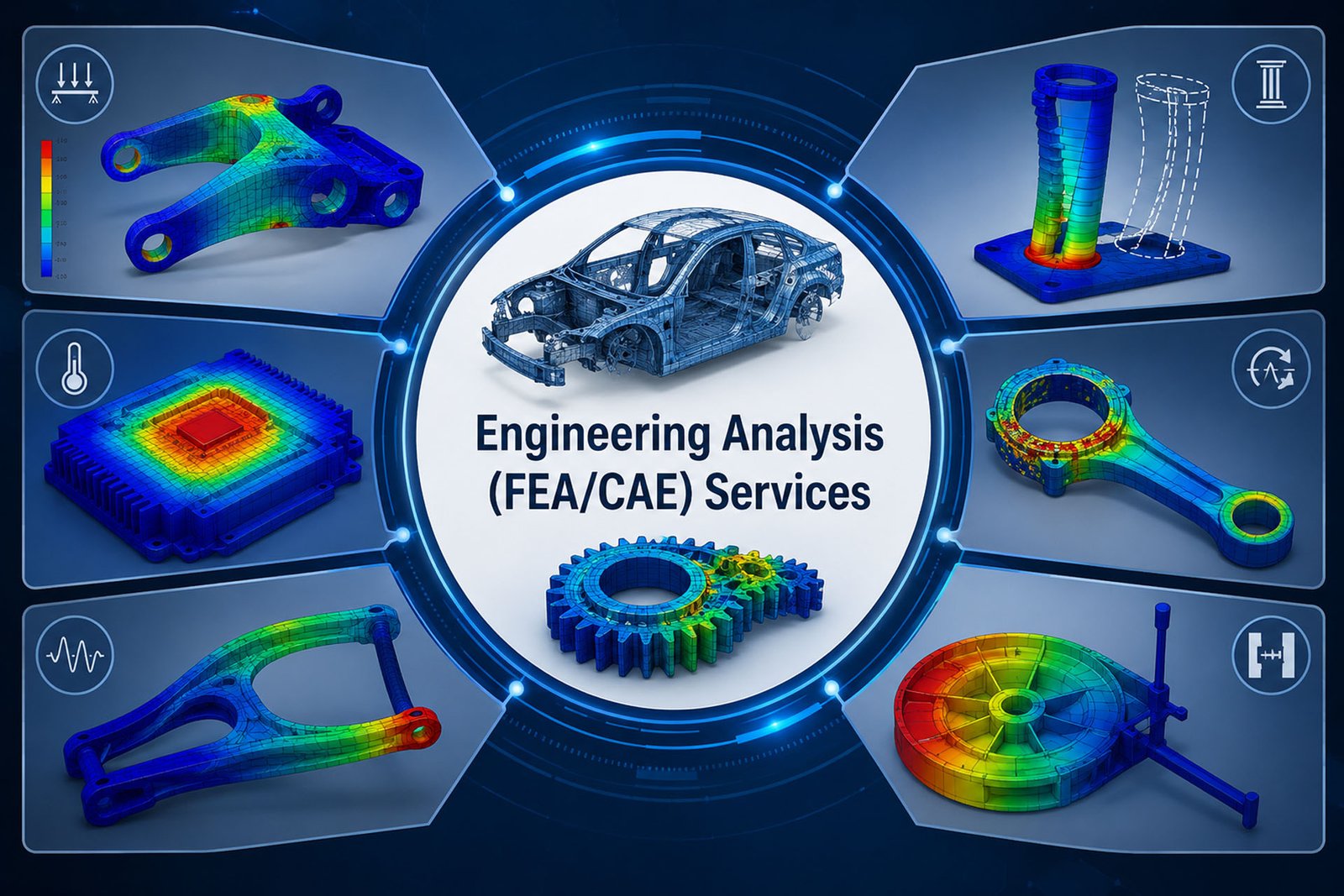
Engineering Analysis (FEA/CAE) Services That Validate Performance Before Production
Know how your design will perform before you commit to tooling, prototyping, or production.
Physical prototyping and field failures are expensive ways to discover a design flaw. Engineering analysis — FEA and CAE simulation — lets you find and fix performance issues while a design still exists only as a digital model, long before manufacturing costs are committed.
Keel Info Solution provides engineering analysis services covering structural, thermal, modal, buckling, fatigue and moldflow simulation. Our analysis engineers work with your existing CAD data to evaluate real-world performance, identify weaknesses, and provide clear, actionable recommendations — not just a report full of numbers.
Whether you need a standalone analysis on an existing design or ongoing simulation support across a product programme, our FEA/CAE services give you the confidence to move forward with data, not guesswork.
Why Engineering Analysis Matters to Your Business
Design failures discovered after tooling or manufacturing are among the most expensive problems an engineering business can face. Simulation-driven validation catches these issues early, when changes are still cheap and fast to make.
Keel Info Solution's engineering analysis services improve:
- Quality — designs verified against real physical performance requirements, not assumptions.
- Efficiency — fewer physical prototypes needed to confirm performance.
- Productivity — internal teams supported by dedicated simulation expertise without building an in-house CAE function.
- Cost savings — design issues caught digitally, before tooling or production costs are incurred.
- Time-to-market — faster confirmation of design performance, reducing delays from late-stage failures.
We support both new product validation and troubleshooting of existing designs experiencing field issues, giving you flexibility in how and when you use our analysis capability.
What We Offer
Static Structural Analysis
We evaluate how your design responds to applied loads, identifying stress concentrations and confirming the design has adequate margin before failure.
Thermal Analysis
Our thermal simulations model heat generation, transfer, and dissipation, helping you avoid overheating, thermal expansion issues, or material degradation in service.
Modal Analysis
We calculate a structure's natural frequencies and mode shapes, identifying resonance risks that could cause vibration, noise, or fatigue problems.
Buckling Analysis
For components under compressive loading, we determine critical buckling loads to confirm structural stability under expected operating conditions.
Fatigue Analysis
We simulate cyclic and repeated loading over the product's service life, predicting fatigue life and identifying areas at risk of long-term failure.
Moldflow Analysis
For injection-moulded components, we simulate the filling, packing, and cooling stages of the moulding process to catch defects before tooling is cut.
Industries We Serve
- Manufacturing — Simulation-driven validation that reduces physical prototyping costs and catches design flaws before they reach the production line.
- Oil & Gas — Structural and thermal analysis for equipment operating under extreme pressure, temperature, and corrosive conditions.
- Sheet Metal — Structural analysis that confirms sheet metal component strength while supporting material and gauge optimisation.
- Heavy Engineering — Detailed structural and fatigue analysis for large equipment subject to high, sustained, or repeated loading.
- Defence — Rigorous performance validation for components that must meet demanding durability and reliability requirements.
- Power — Thermal and structural analysis for equipment operating continuously under variable load and temperature conditions.
- EPC — Analysis support for critical components and structures within engineering, procurement, and construction project scopes.
- Automotive — Fatigue and modal analysis supporting durability and NVH performance across vehicle components and assemblies.
- HVAC — Thermal and structural simulation for equipment and ductwork operating under varying airflow and temperature conditions.
Our Engineering Process
1. Requirement Analysis
We review your CAD data, loading conditions, and performance requirements to scope the appropriate analysis approach.
2. Model Preparation
CAD geometry is prepared and simplified as needed for accurate, efficient simulation without compromising result validity.
3. Simulation Setup
Boundary conditions, material properties, and loading scenarios are defined to represent real-world operating conditions accurately.
4. Analysis Execution
Simulations are run using validated CAE software, with results reviewed for accuracy and engineering sense.
5. Results Interpretation
Our engineers interpret the raw simulation output into clear findings, highlighting risk areas and design implications.
6. Quality Check
Results and recommendations undergo internal technical review before being finalised for delivery.
7. Reporting & Recommendations
We deliver a clear analysis report with actionable design recommendations, not just raw data.
8. Final Delivery
Completed reports and supporting files are delivered in your required format, with our team available to discuss findings.
Software & Technologies We Use
CAE Platforms
- ANSYS — our primary platform for structural, thermal, modal, buckling, and fatigue analysis across a wide range of components and industries.
- Flow — used specifically for injection moulding simulation, identifying fill, warp, and cooling defects before tooling investment.
CAD Platforms
- PTC Creo — used to prepare and adjust source geometry for simulation.
- SolidWorks — supports model preparation and simulation setup for a wide range of components.
- Siemens NX — used for geometry preparation on complex assemblies requiring analysis.
- Autodesk Inventor — supports model handling for analysis of Inventor-designed components.
- AutoCAD — used where 2D reference data supports the analysis scope.
Engineering Data Management
- Windchill — manages analysis inputs, outputs, and revision history alongside design data.
- Teamcenter — keeps analysis results linked to the correct design version across the product lifecycle.
- Autodesk Vault — tracks analysis files and supporting documentation.
- SAP PLM — integrates analysis outcomes with broader engineering and business processes.
Key Benefits
Faster Project Delivery
Simulation-based validation identifies design issues early, avoiding the delays caused by late-stage physical test failures.
Cost Optimisation
Catching design flaws digitally avoids the far higher cost of correcting them after tooling or manufacturing has begun.
Improved Quality
Designs are validated against real physical performance criteria, resulting in more reliable, better-performing products.
Better Collaboration
Clear, well-explained analysis reports give your design and engineering teams a shared, data-backed basis for decisions.
Scalable Engineering Support
Access simulation expertise on a project basis, without the cost of building and maintaining an in-house CAE team.
Compliance with Industry Standards
Analysis work is carried out in line with relevant engineering standards and accepted simulation methodology.
Reduced Engineering Risks
Early identification of structural, thermal, or fatigue risks significantly lowers the chance of costly field failures.
Increased Productivity
Outsourced analysis work frees your internal engineers to focus on design development rather than simulation execution.
Accurate Documentation
Every analysis is delivered with a clear, well-documented report supporting design decisions and compliance records.
Manufacturing Readiness
Validated designs move into manufacturing with confidence, reducing the risk of late-stage, production-halting issues.
Why Choose Keel Info Solution
Dedicated Saudi Support Team
Your analysis requirements are managed by a local team that understands your project context, ensuring clear communication throughout the engagement.
On-site Requirement Study
Where operating conditions are complex or poorly documented, our team can carry out an on-site study to define accurate simulation boundary conditions.
Offshore Engineering Execution (India)
Analysis work is carried out by our experienced CAE engineering team in India, delivering technical depth at a competitive cost.
Faster Turnaround
Our dedicated analysis resourcing allows simulation work to progress quickly, keeping your validation schedule on track.
Cost Savings
Access experienced FEA/CAE expertise without the overhead of employing full-time in-house simulation engineers.
Dedicated Engineering Teams
Consistent analysis engineers stay assigned to your projects, building deeper familiarity with your products over time.
Technical Manpower Supply
We can supply additional analysis engineers to support periods of higher simulation demand on your projects.
Engineering Project Support
From a single analysis task to ongoing validation across a full product programme, our support scales with your needs.
Validate Your Design Before It Costs You
Every hour spent on simulation is an hour saved in prototyping, tooling correction, or field failure response. Keel Info Solution's engineering analysis services give you the technical confidence to move from design to manufacturing without costly surprises.
Get in touch to discuss your analysis requirements and see how our FEA/CAE team can support your next project.